Itis time to begin a “national dialogue on race.” I'm ready. I just reread Obama's book Dreams from my Father:A Story of Race and Inheritance. It has brought me to reflect on the racial influences in my own life and how they have shaped me as an individual. I recall a series of unrelated events that worked together to create the tapestry of my experiences.
1949 (approx.)
My very first recollection of seeing a black person was when I was about six years old. We lived on a farm in rural northern Minnesota. My father had hired a contractor to paint the barn. As with most novel events in our limited world exposure, the younger children were forbidden to be anywhere near. I recall the man who came and spoke with my dad as a white man but the person who actually did the painting was black. At that time, all I knew of black people was that they came to this country as slaves and that it was now illegal to have slaves. When I saw this relationship of the contractor and the painter, in my young mind I was sure he was a slave. But the culture of our home was that children never asked questions so my assumption simply held until I was old enough to understand and reflect on the complete picture. Until then I was certain a slave had painted our barn. It had a tingly feeling. I'm not sure if the unsettledness I felt was seeing this different person, believing my “righteous” father had done something wrong, or simply a fascination When I would want to punish my father, I remember plotting if there were a way I could let someone know that a slave had painted our barn to get my father in trouble. Oh how the minds of young children work.
1959
We later had moved to a larger, nearly suburban, community. My father owned a cafe which also sold tickets for the Greyhound bus. If the cafe was not busy with customers, the passengers usually sat on the stools to wait for their bus. I was sixteen and worked as a waitress for my father. At that time Anoka had no noticeable minorities. There were definitely none in my school. But one day a mixed racial couple came in and bought a bus ticket. At the time, the cafe was empty and the couple sat down on one of the stools. My father promptly went over and sternly said, “Your kind is not welcome here.” He pointed to a sign that declared “We reserve the right to refuse service to anyone” as if that justified his position. They were told to wait outside (fortunately the weather was agreeable). I remember being mortified! I desperately wanted to make amends, apologize, find them a place to sit, anything to correct the injustice I sensed. But I had been raised not to question, contradict, or even suggest that my parent may be wrong. The vision haunts me. Why did I react as I did? Race was not something ever discussed in our home. But something in me knew this was wrong.
Spring 1968
When Martin Luther King was assassinated I was doing a graduate internship at Central High School in St. Paul, Minnesota, a predominately black school. I was teaching a special education class for cognitively delayed students. The students were black, big (compared to myself), and lovable. I saw them as big teddy bears. They actually wanted to learn. As soon as the news was announced that King had been assassinated, the school was dismissed. I was puzzled since other schools were not dismissed. I did not fully understand the significance at the time. But I had spent no time in the school to be familiar with the sentiments or attitudes. I was too busy in my own world raising a family and going to school. But I was fully aware of the struggles that MLK had brought to the forefront and the racial turmoil of the sixties. This was never a wedge between my students and me.
Fall 1968
My husband and I and two small children went to Indonesia to teach for four years. On the initial trip to our new home, we took a 26 hour boat trip from Singapore across the Malacca Straits and up the Siak River. Our sons were aged one and three. The smallest was a tow head. Both had big, blue Scandinavian eyes. In the afternoon I was sitting on deck doing some knitting. My pattern book prominently displayed a very blond, fair, blue eyed child modeling the sweater I was making. Some of the Indonesian women noticed the photo and seemed quite struck with it. I wish I could recall their comments exactly but I remember discreetly putting the pattern photo out of site and feeling quite embarrassed. These Indonesian women who worked for the Americans tried hard to cover themselves and especially their children from the sun in an effort to keep their skin as light as possible. (I recall Obama in his book sharing his confusion at the magazine ad for a product to lighten black people's skin. ) However, when we went to the village or into the jungle areas, skin color was not the locals' concern. Sometimes we even encountered individuals who had never seen white skin. It was an inverse experience to my earliest encounter with differences in race. It was very difficult for us to take our children out of the main camp where we lived because the locals would converge on our children wanting to touch them, unintentionally frightening them. One time we had tried to get them a hair cut in the village. A crowd of little kids gathered to watch and scooped up any scrap of hair that fell to the floor. After that of course, we cut their hair ourselves. In this environment, we were the minority but in a different perspective. We were the haves. And we were reminded of that regularly by our surroundings. I know what it is to be a minority, to be stared at or pointed at. Yet here I was of the “privileged” group.
1978
The next stage of my education came as “the affirmative action officer” in my school district. I was aware I was appointed to this role for my views but how they were so obvious I didn't know. I was apparently less subtle than I was aware. An incident in point: one day as I walked into the teachers' lounge, a group of men had been sitting around a table jawing about something and as I opened the door I heard “a nigger in a wood pile.” The speaker immediately looked at me and apologized for his remark. At least I felt I had brought some awareness to the situation. I know I didn't change behaviors or attitudes.
1991
Brazilians prided themselves on their color blindness. They would tell you what a mix their culture was: Portuguese, Indian, African, and other European and Asian. These nationalities were evident and visible. However I could not help notice that the favelas' (slums) residents were very dark skinned. The housing we were provided was walled and secured and was home to many nationalities. Crime in Sao Paulo was rampant. Each morning at eight o'clock a steady stream of workers poured through security. These were the maids, the cooks, the amahs, and the staff for the complex. These individuals were exclusively the darker skinned persons. I could only be amused at the Brazilian hypocrisy.
1977-1998
I grew up in a home where women were discouraged from college, raised to be wives, mothers and child bearers but we had no voice. In my career as a female in a male dominated profession, I have experienced discrimination both subtle and blatant. I have experienced wage discrimination and been denied promotions because of my gender. But I have never felt the humiliation of being a second class citizen. Each “ism” I believe is separate, unique, and inexcusable. But I am sure my fierce fight to be a full citizen of the world helped me more more accepting of others who may not have opportunities of the majority.
2008
I am embarrassed to tell the latest story because I was a coward. With friends and family I am able to confront a biased joke or comment. However, I was recently playing bridge with a group of women. At the end of the game as we all rose to leave, I heard one woman remark how she would never vote for a black man. I am ashamed to say I continued to walk away without comment. Is it not my responsibility to tastefully but openly reject such idea?. Why was I unable to do so? I have since been plotting what comment to make at our next encounter, devious as I am and desperate to vindicate myself. I have a long way to grow.
Summary
But how did I get here? My oldest brother adopted multi-racial children which was very difficult for my parents. They never really warmed to the idea and walked a delicate line in the family relationships. Those children, though privileged, have struggled with race as well. How did I become who I am? I am delighted that as a country we have made a statement through our recent election even though I know it is not the statement that every American wants to hear. What do I do now? Let's continue the dialogue, not so much of a confusing history but of an enlightened future.
Wednesday, May 6, 2009


Friday, October 3, 2008
Sweden
This is a story different from all of the other travels we have taken. It was an adventure of discovery and roots. Unlike any trip, this was a trip not of tourist sights but of people so the story here is less of a travelog and more personal . As you will read in this narrative, it was the people who made this a unique and fascinating journey into the past in a present day Sweden. Cliff has often said he had a desire to see the land from which his ancestors came. He knew all four of his grandparents were immigrants from Sweden and the names of the towns of their origins. In July of 2008 we attended Svenskarnasdag, a Swedish holiday celebration, in Scandia Minnesota. There was a Swedish Heritage Society there and Cliff sat with them and got the email address of their organization in Leksand, Sweden whom he then hired to research some of his ancestors home sites. (My spellings here are going to be phonetic since the Swedish language has three extra letters which I can't depict on my keyboard and the look and sound of the words don't match as expected.) This started a snowball and our trip emerged. The email exchanges began between Stenoka, a professional with the Society and then Leif, a relative he had found. Together with Cliff's brother Gary and his wife Te we headed off to see the homeland. On Friday night we landed in Stockholm and headed to the only hotel we had reserved in advance. As we walked into the lobby, Gary and Te were waiting and Cliff proceeded to check in. (Imagine now the Swedish accent). A stranger walks into the lobby and begins saying “Cliff and Gary, Cliff and Gary.” Here was Leif, a fifth generation cousin.  He was a young man with excellent English. He had tucked under his arm a book he had spent researching and putting together for ten years! He was a young man with two small children at home and he spent several hours with us. The book was published for the 400th anniversary of Venjan. Venjan was his home town and the town where Cliff's maternal grandmother was born. This book (which he sold for $70) had the family histories( not always accurate as Gary was included but not Cliff) contained lineage, photos, and facts of this small community. However, it was all in Swedish. Leif had made arrangements with a fourth cousin to meet us in Venjan on Saturday and an apartment for us to rent for Saturday and Sunday night. “Now be sure you get there before three o'clock because the grocery store closes at three and there is no restaurant or cafe or coffee house for you to eat at. When you get to the store, tell the clerk to call Brigitt and tell her you have arrived.”
Venjan
Saturday morning we drove north for our 200 mile trip to Venjan. The roads were great and the weather was gray. We passed along countryside that looked like home. The trees were just beginning to turn and the farms were beginning their harvests. Every farm site had numerous buildings. The amazing thing was that they were all barn red with white trim. No deviation. Every farm was meticulously neat, no old cars or machinery, nothing out of place. Each farm had several buildings: two to four two story homes, a barn and several out buildings.
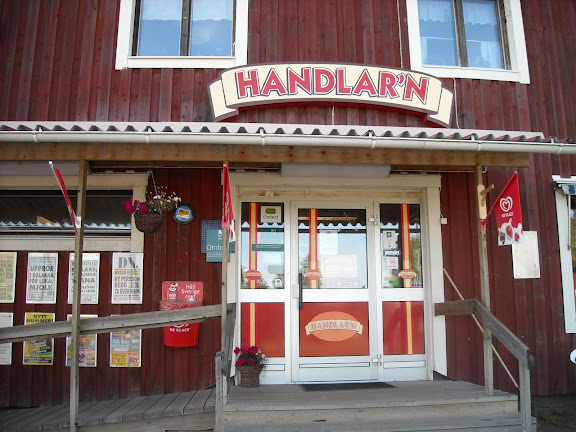 We arrived in Venjan at 2:30 and Te and I began our shopping for the weekend, not sure what our accommodations had to offer. The men spoke to the clerk and in minutes Brigitt arrived (fourth cousin – to our children they tell us). We met Brigitt's SO, Bendt, and quickly headed to our accommodations nearby. Our apartment was the upstairs of one of the houses on a small farm such as we had seen on the way (red of course) with flowers everywhere. We meet our hostess ( a relative as well), who spoke some English and her husband who spoke none. We quickly deposited our gear and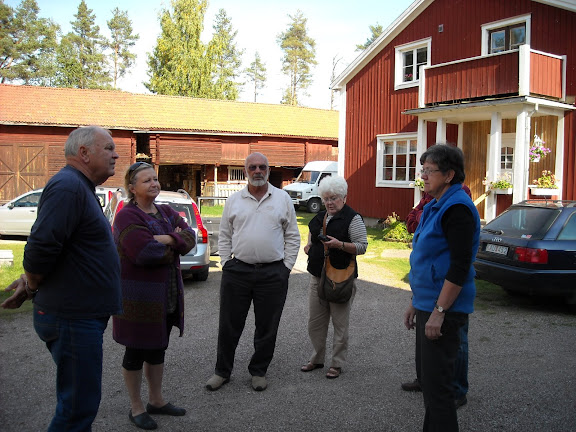
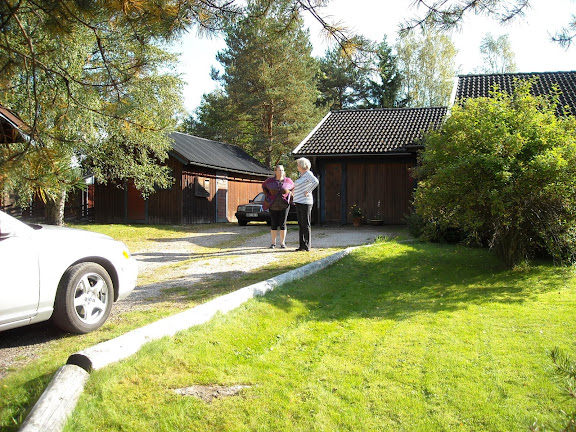 got going for we had things to do and people to see! “Have you eaten?” “We had breakfast,” Te replied. “You must be starved!” Brigitt got on the phone and we headed out. Next we picked up Gertrude, another cousin (fourth to our children), and were introduced to her husband who didn't speak English. She joined us
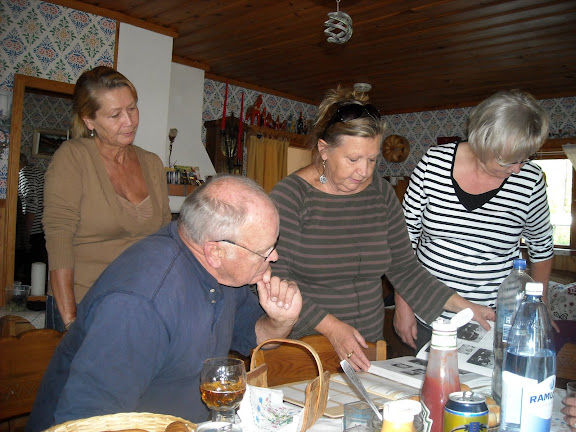
 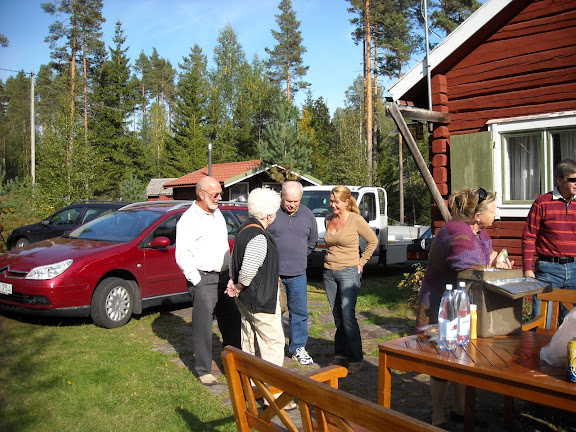 and we headed to Liz's cabin, sister to Brigitt. The cabin is on a lake, and reminded me of our summer cabin in many ways. We met family and friends of hers. She had quickly prepared hot dogs and beer for us (thanks to Brigitt's call). Then came the coffee and the cakes. All the while Brigitt and Liz and Gertrude shared family history, Leif's book in hand and pointed out photos of ancestors. I was more interested in the family dynamics. These are probably irrelevant here so I won't go into them.
 After these discussions most of us walked down the road a hundred yards to a spot where Cliff's maternal grandmother's cabin was relocated. It was built in the 1600's and moved to this site for preservation. Grandma Tapper was born in this cabin and emigrated to America as a young girl. The cabin wasn't open but you could peer in the windows to gage the size and layout. I had to pause to register the significance. From there Gertrude took us to the mountain pasture. It was not exactly a mountain but it is where the farmers took their cattle to pasture in the summer. Several summer homes (red with white trim of course) spotted the terrain and there was a great view as far as the mountains separating Sweden and Norway. A pole, much like a Maypole, was at the center. This was used as a part of the annual Svenkarnasdag celebration. These poles were seen throughout our travels.
After an hour's rest back at the apartment Bendt picked us up for dinner at their home. Their home in Venjan was also a summer home but much less like a cabin. Both Brigett and Bendt worked in Stockholm. After a chili supper with ice cream and cloudberries for desert, we headed back, exhausted. On Sunday morning Gertrude was in charge and we were told to meet her at the church at one p.m. This gave us the chance to explore the farm where we were staying. As with every farm complex we saw en route, the buildings and grounds were immaculate. This farm had three two story homes, a barn, hay and storage building. But as we wondered around, we found a building that was obviously being preserved. We had been encouraged to look in the windows. It was done as a museum of early life would have been. It looked like Grandma Tapper's cabin might have. Meanwhile the farmers were busy digging potatoes. Our hostess had excused herself because they were in full harvest.
Just after we arrived at the church, four other cars arrived. Gertrude and two older cousins who spoke no English, climbed out. Brigett and Bendt came with their two dogs, John (a younger cousin) and his wife Catherine and 14 year old daughter, and another man who had recently been to Minnesota. Everyone was a cousin. Everyone snapped photos.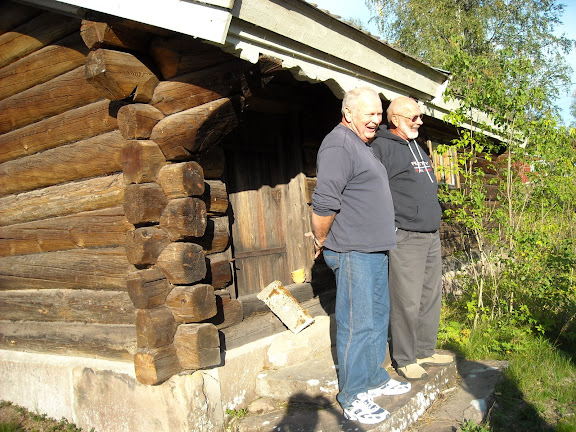 One of our party had a key and we went into the church. I believe there are only Lutheran churches in Sweden and I wondered if anyone actually attended. Each town had a white church with a very tall steeple. After the church and graveyard we went to the local “crafts shop.” Again, someone had a key. This whole entourage crowded in this little place where there were items the locals made and sold – a lot of stitchery, knitting, and wood products. One half of this shop was a specialty oven for baking a particular Swedish flat bread. The process was throughly explained to us. Since none of us knew what it was and it was very tasty, John got on his cell phone and started making calls to find someone who might have some. Three or four calls later, he was successful and we picked some up before dinner that evening so we could sample it. It was nice but I question the effort.
Next stop, the local museum. Venjan is a town of four hundred people (they said). The school had fifteen students but outside of John's teenage daughters, we never saw any children anywhere in the town. We waited at the door for a little old lady in an apron who showed up and opened the door for us. We all went in, down stairs to a small basement room the size of a bedroom. Displayed were many artifacts from the 15th and 16th century, scale models of barrel making and forestry. The collection was amazing but no one ever said “don't touch” and everyone was happy to point things out and explain what we were seeing in that crowded room.
The weather was particularly cold, damp, and windy. But we ventured on to an area park/museum. There was a a 17th century home that had been moved to this spot. We all gathered inside to see how life was in that small house which probably housed ten children, two parents, and grandparents. Newspaper was on the wall for insulation. It was much like Cliff's grandmother's house we had seen the day before. There was an outbuilding that was the larder. Apparently, only the mother had a key to the stores. There was a barn and lots of old farm machinery and implements on display. This museum was part of a larger park and campground on a lake. In the summer bus loads of Danes and Dutch come to camp, away from the crowded cities. Brigitt and Bendt had to leave us to go close their summer home and head back to Stockholm. Gertrude left to go get dinner ready so John and Catherine and their daughter continued on to a steamboat that is currently used to give tourists rides on the lake. The boat is operated totally with volunteers and donations. The engine is run on steam and volunteers cut the wood. John volunteered to keep the engines fired. Originally the steamboat was used for the logging industry.
It was dinner at Gertrude's house next.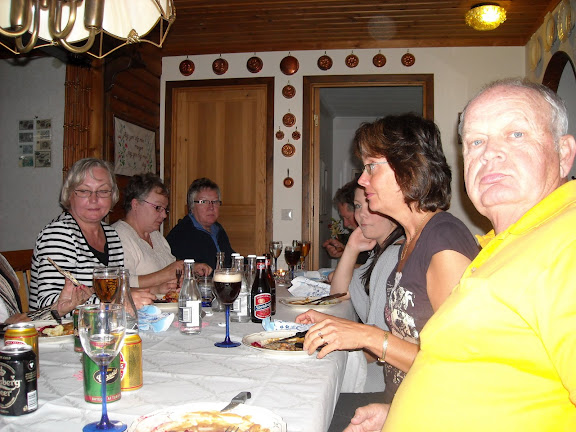 She had a wonderful home on a lake with a great view. Everyone but Brigitt and Bendt were there to eat. It was like a family Thanksgiving. She fixed moose meatloaf, potatoes, and vegetables and there was beer. Then coffee of course and brownies. Thus ended another event filled day. We all said our goodbyes and went back to the apartment to get on the road again.
Leksand -Next Stop
We had an appointment with Stenoka in Leksand at 11 o'clock. He is the genealogy specialist who did a lot of research and made connections for us. We met him at his office at the Swedish genealogy society. I expected a building of musty records, and antiquity.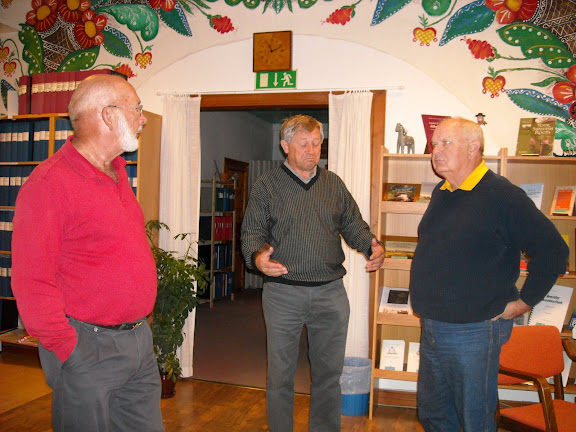 But it was bright and airy with rows and rows of records and microfiche and tables and offices. It was a busy place. First order of business, coffee. Stenoka now knows the Paulson family tree quite well. Cliff and Gary huddled over charts and papers for an hour or so. Cliff was given photo copies of a couple of church records (apparently a primary source for such research) which showed his grandfather's birth. However, the family, great grandparents and all the children, had a big X through their names. That happened when the family emigrated and were no longer part of the church. After profuse thanks and an appointment with Laila at our next stop for the following day, we headed off to find food. We had many signs along the road for restaurang (easily translated), pizzeria (I know that), and kabob (strange trio since I thought I knew what that was). But we decided to try the kabob since it seemed to be so common. We each got a plate of french fries, piled high with gyro veal. The flavor was a subtle eastern cumin and spices combination. Delicious and a delightful surprise. But much too much food. From here, we headed to a hotel close to our next adventure. Cliff called Laila. She spoke very good English, seemed quite bubbly and excited about our visit. She gave Cliff directions and said she would have a photographer who would be taking our photo. “When you get to Ed, keep going 3.2 Swedish miles and watch for a red house on your right at the top of a hill.” We were set to meet at nine o'clock the next day. We all had a laugh about the red house.
Ed – Grandpa Paulson's Birthplace
Next morning we started out with plenty of time to meet Laila. Now those of you who are astute readers here will probably have already detected a slight problem. We got to Ed and went another three kilometers and started watching for the red house on the right on the hill. Things weren't so clear any more. We went four kilometers, we went back to two kilometers. No hill but a few red houses. So we stopped at each and no one had ever heard of Laila. Back to Ed and the gas station. The mailman was just walking by, we asked him if he knew her. Certainly the mailman would! No luck. Cliff went in to call Leila. She's waiting coffee and has appointments for us. So Gary asked the obvious question. What is a Swedish mile? It is ten kilometers. Laila said she and a friend would watch from the porch. Another clue. Now we had another twenty minutes to go. We came to a T in the road, Cliff turned right and Gary shouts, there were two women standing and waving in the front yard. We turned around and headed back. Yes. There was a red house, a slight hill at the T in the road and two women stood with papers watching us. We pulled in and Laila said, “Where were you going, Oslo?” We were now quite close to the Norway border. No time for coffee. We were expected at the farmsite. Leila was not a relative, but someone Stenoka had lined up. She and her friend, the photographer (a digital camera) maintained a website about the genealogy of the area. They jumped in their car and we followed, off the main road onto a gravel road a couple of miles. Not a house or a car in sight and we all pulled over. We were to be met here. No one. Not a sound- just beautiful woods and pines. We chatted a bit, listened for a sound. Impatient Leila finally jumped in her car and drove into woods. Soon she returned with a third car. The latest car now led us up the gravel road, took a left into the woods on a path about a mile and we could see a cabin. We all stopped and were introduced to Odd. He was a large fellow, 72 years old, a Norwegian and owned the property. Apparently his grandmother had purchased the property from Cliff's great grandparents when they emigrated from Sweden. While they talked, Te and I took the cameras and started taking photos of the cabin, rustic but well preserved. Naivete again. This cabin was built by Odd as a hunting cabin. The cabin where Cliff's grandfather, August, was born was behind this one. Now only a few rocks showed where the cabin had been. Te and I then took our cameras and snapped photos of the men standing on the foundation. The photographer also took her photos for the website. (http://www.bullaren-emigranterna.se) Odd took us inside the cabin. We were all wowed. All newly done pine throughout the cabin. There was even electricity but no running water. He had some antique cabinets in there from the 1700's ( from the old family farmhouse?). Gary and Te said from their experience these were easily worth $10,000 each in the US. Outside, there was the original root cellar. Odd had retrieved a gristmill from the nearby river which must have been a Paulson artifact. We were told that Great Grandfather had gone to America to find a place, left Great Grandmother and five small children here, and returned about two years later and the whole family emigrated. I just could not imagine life as a single mother with five small children in that remote spot through what had to have been very tough winters. They had to carry milk out to a main road to send to town. Food and clothing, heat, wildlife – how did she manage alone?
No visit is complete without a cup of coffee so Odd invited us to his home a couple of miles away. Odd lives alone but told us his real wife lived in Oslo. When he built his home out here in the woods, he told his girlfriend if she wanted to live with him this was where he was going to live. She came for a few days and left. It was too lonely. Odd had a beautiful place, all wood inside and out but very remote.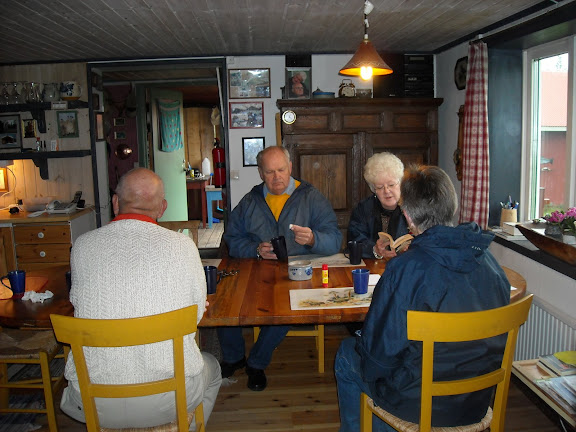 He lived alone and hunted and fished. In his earlier life he was an engineer on oil tankers. He was very proud of his home as he should be. He was happy to show us around. Laila kept prompting him for the coffee. “Should I heat the water?" But he was unfazed. Obviously he is an avid reader. He had many books and a TV and a fireplace. There was electricity and running water. There was a loft for the bedroom. I kept envisioning the piles of snow outside in the winter. Soon he set out seven cups. “Can I start the coffee?” Hemingway was on the table (for effect?). You could tell he loved the quiet life in the woods. We all sat at the table finally and he brought out a jar of instant coffee and poured lukewarm water in our cups. Then he fetched a tin of cookies that had Gut Yule on them. A true bachelor's effort at hospitality. He was well-meaning and kind. On the way out, he proudly showed his shed where he had added a bedroom for guests. His hunting buddies didn't like to pay the price of a hotel so looked to him for lodging. Then we were back to Leila's house where she showed us their website (http://www.bullaren-emigranterna.se) and talked genealogy . Then on eastward we went to keep our next rendezvous.
Vaxjo - Paternal Grandparents Area
We arrived in Vaxjo (an impossible pronunciation), on Wednesday. Every town of any size has a tourist/information bureau which will help with accommodations. So we followed the signs to a very modern library which housed the tourist bureau. Cliff had heard from others that they could help find a stuga ( a cabin you can rent) or a B and B or a hotel. He was eager to stay in stuga. However, being off tourist season, there were none in the vacinity available. Our next best bet was a B and B where we could at least meet some people. They staff graciously accommodated us but we had an afternoon to use. Cliff had read that there was an emigrant museum that was a must see if you are searching for your ancestors. It was within walking distance and a worthwhile stop.
Many of you may be aware of Wilhelm Moberg, who wrote “The Immigrants”. This book told the story of Karl Oscar who emigrated to America with his family. It was eventually a movie. The family in this book settled between Lindstrom, Minnesota and Taylors Falls. There is a whole room in this museum devoted to Moberg and his work. Outside the museum stands a replica of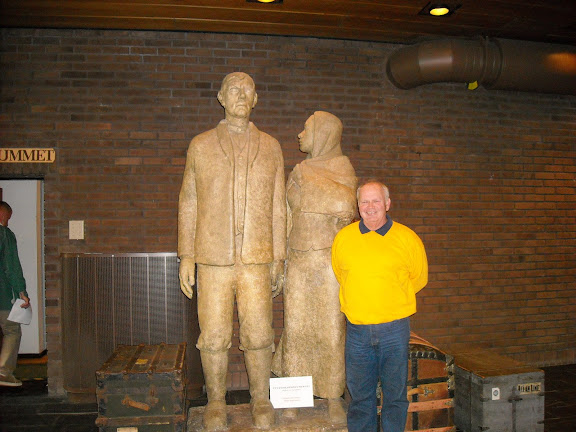 the statue that prominently sits in Lindstrom (which we see often as we go into Minnesota). The statue depicts Karl Oscar and his wife Christina who is looking over her shoulder back at the old country she has left. The water tower in Lindstrom is painted with Swedish colors, has a coffee pot atop and says “Wilkommen til Lindstrom.” The museum tells of the famine in Sweden which spurred about one-third of the Swedes to emigrate. It chronicles their travels, Ellis Island, and their settlements in America. Cliff's ancestors came to Minnesota and settled northwest of the Lindstrom area. Again, the land looked so much like their home in Sweden. So much of the museum was familiar territory.
Later that afternoon we found our B and B. A quite area on the edge of the city. The host spoke no English and the hostess barely managed but we did fine. And in the morning we were served a grand breakfast as we had become accustomed to here. Meat, cheese, caviar, breads and jams, boiled eggs, coffee of course, juice, - a royal feast before we set out for the most thorough stop of our trip.
We drove up to the church in Alguht for our nine o'clock meeting with Solbritt and saw three cars waited for us, one sported an American flag. We were greeted by the hard-working, tenacious Solbritt, Folke - the erstwhile American, and Gosta. Solbritt distributed a three page document on the ancestry plus a schedule for the day. She had really done her homework and had obviously spent many hours in preparation. In her trunk she had rubber boots for Te and me. We were both in sandals and after some insisting, put them on and glad we had done so. Solbritt said we would eat later, a picnic if it was nice or at Gosta's house if the weather was rainy. She had folding chairs and picnic baskets in her car.
That day we explored the background of Samuel, Cliff's paternal great grandfather. The sites we visited were mostly the remains of foundations. But we followed the trail of his history. The first stop was guided by Gosta as his own home was next to this site. Gosta was a tall unassuming Swede with a ready smile. We walked into a wooded area and explored the birthsite of Samuel.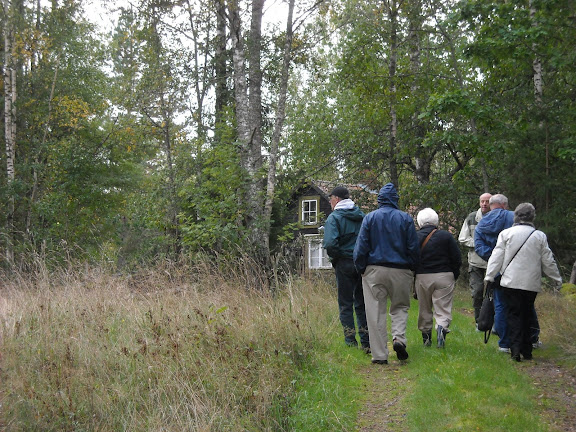 Then walked to another site where Samuel's father had lived. He had been a “ragpicker,” someone who purchased rags from which to make paper. We visited the site where the paper factory was, and a monument to that business. Folke kept saying things like, Samuel would like this...Samuel would have walked here - keeping Samuel and his life in our thoughts. After several stops, it was coffee time. Because the weather was not agreeable, we went to Gosta's house. He pulled into his driveway, went to a storage shed and picked up stale bread and food pellets. We followed. He three the pellets into a pond and such a flurry of fish I hadn't seen since the piranhas in the Amazon! The fish in that pond were at least 10 inches and hungry. He just grinned.
 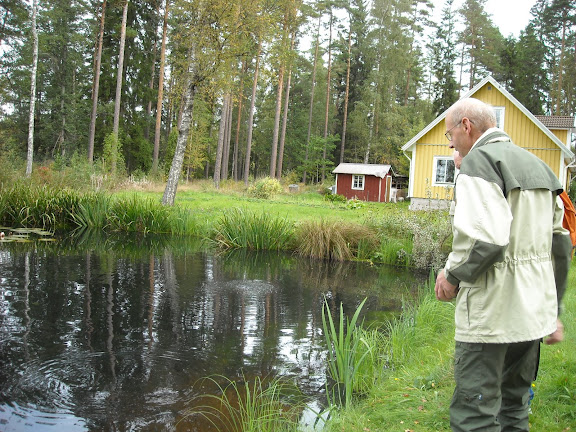 There was a bubbler in the pond which kept the pond from freezing over and oxygenated. He pulled 325 rainbow trout from that pond last year. The grounds were well groomed with several outbuildings, yellow, not red. It seems in the more southern regions, red is not a requirement. Solbritt unloaded her car of two picnic baskets and three thermoses of coffee. As we entered his house, Gosta said his wife lived five miles down the road. No more questions. He lived alone but his home was immaculate and beautiful. Immediately he steered the ladies to the two bathrooms (obviously he knew women) and checked for the necessary papers. Such beautiful tile work and colors in the bathrooms. Solbritt laid out the coffee and two wonderful cakes while the seven of us enjoyed the nourishment and conversation. Gosta had to go to work at two o'clock. His part was done so we left him, our lives richer.
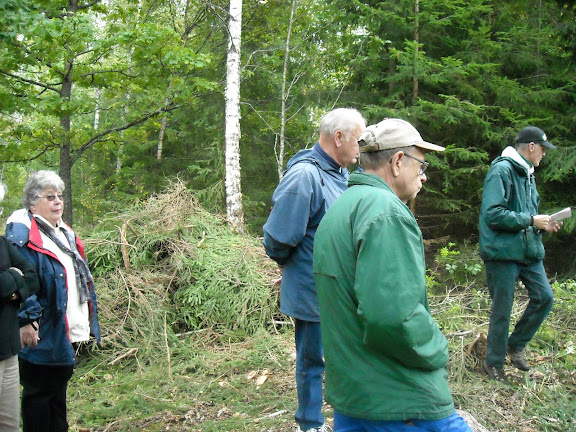 We drove down the road a bit and there an elderly gentleman stood by the road and waited for us. Solbritt was amazing. Lenik was a bachelor of 82 years. He had spent many hours in preparation for our visit. A path about ten feet wide had been cleared for us to go out back to the sites of homes of Samuel at various stages. He had even felled two trees of substantial size so which had grown up through the foundation. I'm sure he would use the wood but this was extraordinary effort for our benefit. He was an accomplished carpenter and had made two wooden butter spreaders for Te and me. We were moved by the personal touch he had made for total strangers. Lenik gave us a tour of his workshop and let us look inside one structure that was being restored. He was proud and we were honored.
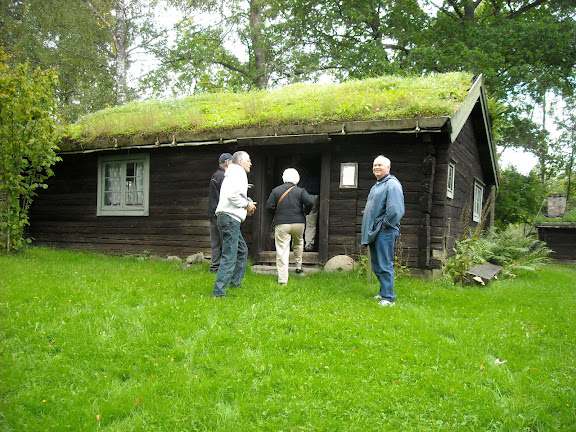 We had to hustle a bit to keep on schedule. Solbritt said goodbye and Folke continued with us. I called Folke the American Swede because he had lived and worked in Minnesota for 35 years. He was married to an American but they had returned to Sweden to retire. We proceeded now to the local Historical Society. Here we were greeted by Folke's sister, her husband and a friend. As he showed us about the grounds, the women prepared food. Inside this historical building, there was a warm fire going, and the table set. We were served a wonderful soup, open faced sandwiches, coffee (of course) and a delicious almond cheesecake. We all felt we had made a new friend but it was time to say goodbye. Folke and Solbritt are still sending us information. The efforts on our behalf just continue.
Paternal Grandmother
It was now time to make our last scheduled visit near Alught. She was Anna Katarina
. When Anna Katarina was eleven years old the rest of her family emigrated to America. Why Anna was left behind isn't known. However, she lived with her grandparents and worked as a maid until she met and married Samuel ( 12 years her senior) who after ten years of marriage also emigrated. Whether Anna met her parents again in the United States is something yet to be discovered. So the search goes on.
But this is also the story of our gracious Swedish hosts. Stenoka had arranged for us to meet Margit for this part of our journey. We met at the Emigrant Museum we visited two days earlier. She, her daughter Maria, the fluent one in English, and Dennis her husband were deep into the archives. Genealogy people amaze me. By this time, every one was wearing down. There was information overkill and we had a suspicion we were in for another Solbritt experience, as wonderful as that was. However, too many more “piles of rocks” as we called them was not what we were seeking. After the greeting we made it known that we had a timeline and needed to head north by 2 p.m. The cell phone came out. I assume some plans were being changed. Did we want to go into the archives? No, we agreed time would not permit. We drove to another small village, went into the local library, copied documents, got a couple of historical architecture books etc. (Te and I caught up on emails.) This family was another special encounter. We drove around and found the homesite we assumed was that of Anna Katarina and discussed her history and how she may have met Samuel. (I regret my batteries were out in my camera at this point.)
We were deep into glassblowing country even though the industry has dwindled dramatically. So when asked if we were interested in a factory, we unanimously agreed. The factory was busy making specialty items. What amazed us , for all the environmental concerns of the country, the safety standards seemed lacking – at least here. The work was hot and intense as you may imagine. We bought a few souvenirs. The website for the factory is www.bergdala.com if you are interested. There was a restaurang on site and we were all hungry. There was a one item menu – like a hamburger steak with potatoes and vegetables. Coffee and almond cheesecake for desert. Never too much cheesecake. Again time to say goodbye.
Finale
We headed back towards Stockholm where we spent our last day as a true tourist. Thus, one more story. On Sunday morning we were looking for the famous ship museum but wandered around unsuccessful. We stopped an elderly gentleman in a suit on the street to ask directions. (Now hear the accent.) "Oh, sorry my English no so gut. I'm Italian but live here 55 years. My English no so gut. Museum way far. You got room, I show you." He climbed in the car and showed the direction. We drove across the city and asked him how he would get back. "No problem. I take bus. I have card. It free. No Problem. You just tell all the Italians in America hello from Camillo." And he left us at the museum. Again the hospitality showed through.
I know this had been excessively long, yet I feel I have omitted so many experiences. But it was definitely the people in the adventure that are the focus. I look at the pictures and smile at their faces. I think of the countless hours that were invested in us. The genuine interest and caring everyone showed was remarkable. Even the follow-up we continue to get. If you've been able to endure my ramblings through this, you may understand my wish to have some sort of a tribute to all these individuals. Brigitt and the others were related but Laila, Solbritt, Folke, Margit and all of the people who spent time with us volunteered their time and efforts. And of course, Camillo. I shall not forget the Swedes.
 He was a young man with excellent English. He had tucked under his arm a book he had spent researching and putting together for ten years! He was a young man with two small children at home and he spent several hours with us. The book was published for the 400th anniversary of Venjan. Venjan was his home town and the town where Cliff's maternal grandmother was born. This book (which he sold for $70) had the family histories( not always accurate as Gary was included but not Cliff) contained lineage, photos, and facts of this small community. However, it was all in Swedish. Leif had made arrangements with a fourth cousin to meet us in Venjan on Saturday and an apartment for us to rent for Saturday and Sunday night. “Now be sure you get there before three o'clock because the grocery store closes at three and there is no restaurant or cafe or coffee house for you to eat at. When you get to the store, tell the clerk to call Brigitt and tell her you have arrived.”
Venjan
Saturday morning we drove north for our 200 mile trip to Venjan. The roads were great and the weather was gray. We passed along countryside that looked like home. The trees were just beginning to turn and the farms were beginning their harvests. Every farm site had numerous buildings. The amazing thing was that they were all barn red with white trim. No deviation. Every farm was meticulously neat, no old cars or machinery, nothing out of place. Each farm had several buildings: two to four two story homes, a barn and several out buildings.
We arrived in Venjan at 2:30 and Te and I began our shopping for the weekend, not sure what our accommodations had to offer. The men spoke to the clerk and in minutes Brigitt arrived (fourth cousin – to our children they tell us). We met Brigitt's SO, Bendt, and quickly headed to our accommodations nearby. Our apartment was the upstairs of one of the houses on a small farm such as we had seen on the way (red of course) with flowers everywhere. We meet our hostess ( a relative as well), who spoke some English and her husband who spoke none. We quickly deposited our gear and got going for we had things to do and people to see! “Have you eaten?” “We had breakfast,” Te replied. “You must be starved!” Brigitt got on the phone and we headed out. Next we picked up Gertrude, another cousin (fourth to our children), and were introduced to her husband who didn't speak English. She joined us and we headed to Liz's cabin, sister to Brigitt. The cabin is on a lake, and reminded me of our summer cabin in many ways. We met family and friends of hers. She had quickly prepared hot dogs and beer for us (thanks to Brigitt's call). Then came the coffee and the cakes. All the while Brigitt and Liz and Gertrude shared family history, Leif's book in hand and pointed out photos of ancestors. I was more interested in the family dynamics. These are probably irrelevant here so I won't go into them.After these discussions most of us walked down the road a hundred yards to a spot where Cliff's maternal grandmother's cabin was relocated. It was built in the 1600's and moved to this site for preservation. Grandma Tapper was born in this cabin and emigrated to America as a young girl. The cabin wasn't open but you could peer in the windows to gage the size and layout. I had to pause to register the significance. From there Gertrude took us to the mountain pasture. It was not exactly a mountain but it is where the farmers took their cattle to pasture in the summer. Several summer homes (red with white trim of course) spotted the terrain and there was a great view as far as the mountains separating Sweden and Norway. A pole, much like a Maypole, was at the center. This was used as a part of the annual Svenkarnasdag celebration. These poles were seen throughout our travels.After an hour's rest back at the apartment Bendt picked us up for dinner at their home. Their home in Venjan was also a summer home but much less like a cabin. Both Brigett and Bendt worked in Stockholm. After a chili supper with ice cream and cloudberries for desert, we headed back, exhausted. On Sunday morning Gertrude was in charge and we were told to meet her at the church at one p.m. This gave us the chance to explore the farm where we were staying. As with every farm complex we saw en route, the buildings and grounds were immaculate. This farm had three two story homes, a barn, hay and storage building. But as we wondered around, we found a building that was obviously being preserved. We had been encouraged to look in the windows. It was done as a museum of early life would have been. It looked like Grandma Tapper's cabin might have. Meanwhile the farmers were busy digging potatoes. Our hostess had excused herself because they were in full harvest.
Just after we arrived at the church, four other cars arrived. Gertrude and two older cousins who spoke no English, climbed out. Brigett and Bendt came with their two dogs, John (a younger cousin) and his wife Catherine and 14 year old daughter, and another man who had recently been to Minnesota. Everyone was a cousin. Everyone snapped photos.
One of our party had a key and we went into the church. I believe there are only Lutheran churches in Sweden and I wondered if anyone actually attended. Each town had a white church with a very tall steeple. After the church and graveyard we went to the local “crafts shop.” Again, someone had a key. This whole entourage crowded in this little place where there were items the locals made and sold – a lot of stitchery, knitting, and wood products. One half of this shop was a specialty oven for baking a particular Swedish flat bread. The process was throughly explained to us. Since none of us knew what it was and it was very tasty, John got on his cell phone and started making calls to find someone who might have some. Three or four calls later, he was successful and we picked some up before dinner that evening so we could sample it. It was nice but I question the effort.Next stop, the local museum. Venjan is a town of four hundred people (they said). The school had fifteen students but outside of John's teenage daughters, we never saw any children anywhere in the town. We waited at the door for a little old lady in an apron who showed up and opened the door for us. We all went in, down stairs to a small basement room the size of a bedroom. Displayed were many artifacts from the 15th and 16th century, scale models of barrel making and forestry. The collection was amazing but no one ever said “don't touch” and everyone was happy to point things out and explain what we were seeing in that crowded room.
The weather was particularly cold, damp, and windy. But we ventured on to an area park/museum. There was a a 17th century home that had been moved to this spot. We all gathered inside to see how life was in that small house which probably housed ten children, two parents, and grandparents. Newspaper was on the wall for insulation. It was much like Cliff's grandmother's house we had seen the day before. There was an outbuilding that was the larder. Apparently, only the mother had a key to the stores. There was a barn and lots of old farm machinery and implements on display. This museum was part of a larger park and campground on a lake. In the summer bus loads of Danes and Dutch come to camp, away from the crowded cities. Brigitt and Bendt had to leave us to go close their summer home and head back to Stockholm. Gertrude left to go get dinner ready so John and Catherine and their daughter continued on to a steamboat that is currently used to give tourists rides on the lake. The boat is operated totally with volunteers and donations. The engine is run on steam and volunteers cut the wood. John volunteered to keep the engines fired. Originally the steamboat was used for the logging industry.
It was dinner at Gertrude's house next.
She had a wonderful home on a lake with a great view. Everyone but Brigitt and Bendt were there to eat. It was like a family Thanksgiving. She fixed moose meatloaf, potatoes, and vegetables and there was beer. Then coffee of course and brownies. Thus ended another event filled day. We all said our goodbyes and went back to the apartment to get on the road again.Leksand -Next Stop
We had an appointment with Stenoka in Leksand at 11 o'clock. He is the genealogy specialist who did a lot of research and made connections for us. We met him at his office at the Swedish genealogy society. I expected a building of musty records, and antiquity.
But it was bright and airy with rows and rows of records and microfiche and tables and offices. It was a busy place. First order of business, coffee. Stenoka now knows the Paulson family tree quite well. Cliff and Gary huddled over charts and papers for an hour or so. Cliff was given photo copies of a couple of church records (apparently a primary source for such research) which showed his grandfather's birth. However, the family, great grandparents and all the children, had a big X through their names. That happened when the family emigrated and were no longer part of the church. After profuse thanks and an appointment with Laila at our next stop for the following day, we headed off to find food. We had many signs along the road for restaurang (easily translated), pizzeria (I know that), and kabob (strange trio since I thought I knew what that was). But we decided to try the kabob since it seemed to be so common. We each got a plate of french fries, piled high with gyro veal. The flavor was a subtle eastern cumin and spices combination. Delicious and a delightful surprise. But much too much food. From here, we headed to a hotel close to our next adventure. Cliff called Laila. She spoke very good English, seemed quite bubbly and excited about our visit. She gave Cliff directions and said she would have a photographer who would be taking our photo. “When you get to Ed, keep going 3.2 Swedish miles and watch for a red house on your right at the top of a hill.” We were set to meet at nine o'clock the next day. We all had a laugh about the red house.Ed – Grandpa Paulson's Birthplace
Next morning we started out with plenty of time to meet Laila. Now those of you who are astute readers here will probably have already detected a slight problem. We got to Ed and went another three kilometers and started watching for the red house on the right on the hill. Things weren't so clear any more. We went four kilometers, we went back to two kilometers. No hill but a few red houses. So we stopped at each and no one had ever heard of Laila. Back to Ed and the gas station. The mailman was just walking by, we asked him if he knew her. Certainly the mailman would! No luck. Cliff went in to call Leila. She's waiting coffee and has appointments for us. So Gary asked the obvious question. What is a Swedish mile? It is ten kilometers. Laila said she and a friend would watch from the porch. Another clue. Now we had another twenty minutes to go. We came to a T in the road, Cliff turned right and Gary shouts, there were two women standing and waving in the front yard. We turned around and headed back. Yes. There was a red house, a slight hill at the T in the road and two women stood with papers watching us. We pulled in and Laila said, “Where were you going, Oslo?” We were now quite close to the Norway border. No time for coffee. We were expected at the farmsite. Leila was not a relative, but someone Stenoka had lined up. She and her friend, the photographer (a digital camera) maintained a website about the genealogy of the area. They jumped in their car and we followed, off the main road onto a gravel road a couple of miles. Not a house or a car in sight and we all pulled over. We were to be met here. No one. Not a sound- just beautiful woods and pines. We chatted a bit, listened for a sound. Impatient Leila finally jumped in her car and drove into woods. Soon she returned with a third car. The latest car now led us up the gravel road, took a left into the woods on a path about a mile and we could see a cabin. We all stopped and were introduced to Odd. He was a large fellow, 72 years old, a Norwegian and owned the property. Apparently his grandmother had purchased the property from Cliff's great grandparents when they emigrated from Sweden. While they talked, Te and I took the cameras and started taking photos of the cabin, rustic but well preserved. Naivete again. This cabin was built by Odd as a hunting cabin. The cabin where Cliff's grandfather, August, was born was behind this one. Now only a few rocks showed where the cabin had been. Te and I then took our cameras and snapped photos of the men standing on the foundation. The photographer also took her photos for the website. (http://www.bullaren-emigranterna.se) Odd took us inside the cabin. We were all wowed. All newly done pine throughout the cabin. There was even electricity but no running water. He had some antique cabinets in there from the 1700's ( from the old family farmhouse?). Gary and Te said from their experience these were easily worth $10,000 each in the US. Outside, there was the original root cellar. Odd had retrieved a gristmill from the nearby river which must have been a Paulson artifact. We were told that Great Grandfather had gone to America to find a place, left Great Grandmother and five small children here, and returned about two years later and the whole family emigrated. I just could not imagine life as a single mother with five small children in that remote spot through what had to have been very tough winters. They had to carry milk out to a main road to send to town. Food and clothing, heat, wildlife – how did she manage alone?
No visit is complete without a cup of coffee so Odd invited us to his home a couple of miles away. Odd lives alone but told us his real wife lived in Oslo. When he built his home out here in the woods, he told his girlfriend if she wanted to live with him this was where he was going to live. She came for a few days and left. It was too lonely. Odd had a beautiful place, all wood inside and out but very remote.
He lived alone and hunted and fished. In his earlier life he was an engineer on oil tankers. He was very proud of his home as he should be. He was happy to show us around. Laila kept prompting him for the coffee. “Should I heat the water?" But he was unfazed. Obviously he is an avid reader. He had many books and a TV and a fireplace. There was electricity and running water. There was a loft for the bedroom. I kept envisioning the piles of snow outside in the winter. Soon he set out seven cups. “Can I start the coffee?” Hemingway was on the table (for effect?). You could tell he loved the quiet life in the woods. We all sat at the table finally and he brought out a jar of instant coffee and poured lukewarm water in our cups. Then he fetched a tin of cookies that had Gut Yule on them. A true bachelor's effort at hospitality. He was well-meaning and kind. On the way out, he proudly showed his shed where he had added a bedroom for guests. His hunting buddies didn't like to pay the price of a hotel so looked to him for lodging. Then we were back to Leila's house where she showed us their website (http://www.bullaren-emigranterna.se) and talked genealogy . Then on eastward we went to keep our next rendezvous.Vaxjo - Paternal Grandparents Area
We arrived in Vaxjo (an impossible pronunciation), on Wednesday. Every town of any size has a tourist/information bureau which will help with accommodations. So we followed the signs to a very modern library which housed the tourist bureau. Cliff had heard from others that they could help find a stuga ( a cabin you can rent) or a B and B or a hotel. He was eager to stay in stuga. However, being off tourist season, there were none in the vacinity available. Our next best bet was a B and B where we could at least meet some people. They staff graciously accommodated us but we had an afternoon to use. Cliff had read that there was an emigrant museum that was a must see if you are searching for your ancestors. It was within walking distance and a worthwhile stop.
Many of you may be aware of Wilhelm Moberg, who wrote “The Immigrants”. This book told the story of Karl Oscar who emigrated to America with his family. It was eventually a movie. The family in this book settled between Lindstrom, Minnesota and Taylors Falls. There is a whole room in this museum devoted to Moberg and his work. Outside the museum stands a replica of
the statue that prominently sits in Lindstrom (which we see often as we go into Minnesota). The statue depicts Karl Oscar and his wife Christina who is looking over her shoulder back at the old country she has left. The water tower in Lindstrom is painted with Swedish colors, has a coffee pot atop and says “Wilkommen til Lindstrom.” The museum tells of the famine in Sweden which spurred about one-third of the Swedes to emigrate. It chronicles their travels, Ellis Island, and their settlements in America. Cliff's ancestors came to Minnesota and settled northwest of the Lindstrom area. Again, the land looked so much like their home in Sweden. So much of the museum was familiar territory.Later that afternoon we found our B and B. A quite area on the edge of the city. The host spoke no English and the hostess barely managed but we did fine. And in the morning we were served a grand breakfast as we had become accustomed to here. Meat, cheese, caviar, breads and jams, boiled eggs, coffee of course, juice, - a royal feast before we set out for the most thorough stop of our trip.
We drove up to the church in Alguht for our nine o'clock meeting with Solbritt and saw three cars waited for us, one sported an American flag. We were greeted by the hard-working, tenacious Solbritt, Folke - the erstwhile American, and Gosta. Solbritt distributed a three page document on the ancestry plus a schedule for the day. She had really done her homework and had obviously spent many hours in preparation. In her trunk she had rubber boots for Te and me. We were both in sandals and after some insisting, put them on and glad we had done so. Solbritt said we would eat later, a picnic if it was nice or at Gosta's house if the weather was rainy. She had folding chairs and picnic baskets in her car.
That day we explored the background of Samuel, Cliff's paternal great grandfather. The sites we visited were mostly the remains of foundations. But we followed the trail of his history. The first stop was guided by Gosta as his own home was next to this site. Gosta was a tall unassuming Swede with a ready smile. We walked into a wooded area and explored the birthsite of Samuel.
Then walked to another site where Samuel's father had lived. He had been a “ragpicker,” someone who purchased rags from which to make paper. We visited the site where the paper factory was, and a monument to that business. Folke kept saying things like, Samuel would like this...Samuel would have walked here - keeping Samuel and his life in our thoughts. After several stops, it was coffee time. Because the weather was not agreeable, we went to Gosta's house. He pulled into his driveway, went to a storage shed and picked up stale bread and food pellets. We followed. He three the pellets into a pond and such a flurry of fish I hadn't seen since the piranhas in the Amazon! The fish in that pond were at least 10 inches and hungry. He just grinned. There was a bubbler in the pond which kept the pond from freezing over and oxygenated. He pulled 325 rainbow trout from that pond last year. The grounds were well groomed with several outbuildings, yellow, not red. It seems in the more southern regions, red is not a requirement. Solbritt unloaded her car of two picnic baskets and three thermoses of coffee. As we entered his house, Gosta said his wife lived five miles down the road. No more questions. He lived alone but his home was immaculate and beautiful. Immediately he steered the ladies to the two bathrooms (obviously he knew women) and checked for the necessary papers. Such beautiful tile work and colors in the bathrooms. Solbritt laid out the coffee and two wonderful cakes while the seven of us enjoyed the nourishment and conversation. Gosta had to go to work at two o'clock. His part was done so we left him, our lives richer.We drove down the road a bit and there an elderly gentleman stood by the road and waited for us. Solbritt was amazing. Lenik was a bachelor of 82 years. He had spent many hours in preparation for our visit. A path about ten feet wide had been cleared for us to go out back to the sites of homes of Samuel at various stages. He had even felled two trees of substantial size so which had grown up through the foundation. I'm sure he would use the wood but this was extraordinary effort for our benefit. He was an accomplished carpenter and had made two wooden butter spreaders for Te and me. We were moved by the personal touch he had made for total strangers. Lenik gave us a tour of his workshop and let us look inside one structure that was being restored. He was proud and we were honored.We had to hustle a bit to keep on schedule. Solbritt said goodbye and Folke continued with us. I called Folke the American Swede because he had lived and worked in Minnesota for 35 years. He was married to an American but they had returned to Sweden to retire. We proceeded now to the local Historical Society. Here we were greeted by Folke's sister, her husband and a friend. As he showed us about the grounds, the women prepared food. Inside this historical building, there was a warm fire going, and the table set. We were served a wonderful soup, open faced sandwiches, coffee (of course) and a delicious almond cheesecake. We all felt we had made a new friend but it was time to say goodbye. Folke and Solbritt are still sending us information. The efforts on our behalf just continue.Paternal Grandmother
It was now time to make our last scheduled visit near Alught. She was Anna Katarina
. When Anna Katarina was eleven years old the rest of her family emigrated to America. Why Anna was left behind isn't known. However, she lived with her grandparents and worked as a maid until she met and married Samuel ( 12 years her senior) who after ten years of marriage also emigrated. Whether Anna met her parents again in the United States is something yet to be discovered. So the search goes on.
But this is also the story of our gracious Swedish hosts. Stenoka had arranged for us to meet Margit for this part of our journey. We met at the Emigrant Museum we visited two days earlier. She, her daughter Maria, the fluent one in English, and Dennis her husband were deep into the archives. Genealogy people amaze me. By this time, every one was wearing down. There was information overkill and we had a suspicion we were in for another Solbritt experience, as wonderful as that was. However, too many more “piles of rocks” as we called them was not what we were seeking. After the greeting we made it known that we had a timeline and needed to head north by 2 p.m. The cell phone came out. I assume some plans were being changed. Did we want to go into the archives? No, we agreed time would not permit. We drove to another small village, went into the local library, copied documents, got a couple of historical architecture books etc. (Te and I caught up on emails.) This family was another special encounter. We drove around and found the homesite we assumed was that of Anna Katarina and discussed her history and how she may have met Samuel. (I regret my batteries were out in my camera at this point.)
We were deep into glassblowing country even though the industry has dwindled dramatically. So when asked if we were interested in a factory, we unanimously agreed. The factory was busy making specialty items. What amazed us , for all the environmental concerns of the country, the safety standards seemed lacking – at least here. The work was hot and intense as you may imagine. We bought a few souvenirs. The website for the factory is www.bergdala.com if you are interested. There was a restaurang on site and we were all hungry. There was a one item menu – like a hamburger steak with potatoes and vegetables. Coffee and almond cheesecake for desert. Never too much cheesecake. Again time to say goodbye.
Finale
We headed back towards Stockholm where we spent our last day as a true tourist. Thus, one more story. On Sunday morning we were looking for the famous ship museum but wandered around unsuccessful. We stopped an elderly gentleman in a suit on the street to ask directions. (Now hear the accent.) "Oh, sorry my English no so gut. I'm Italian but live here 55 years. My English no so gut. Museum way far. You got room, I show you." He climbed in the car and showed the direction. We drove across the city and asked him how he would get back. "No problem. I take bus. I have card. It free. No Problem. You just tell all the Italians in America hello from Camillo." And he left us at the museum. Again the hospitality showed through.
I know this had been excessively long, yet I feel I have omitted so many experiences. But it was definitely the people in the adventure that are the focus. I look at the pictures and smile at their faces. I think of the countless hours that were invested in us. The genuine interest and caring everyone showed was remarkable. Even the follow-up we continue to get. If you've been able to endure my ramblings through this, you may understand my wish to have some sort of a tribute to all these individuals. Brigitt and the others were related but Laila, Solbritt, Folke, Margit and all of the people who spent time with us volunteered their time and efforts. And of course, Camillo. I shall not forget the Swedes.
Wednesday, March 26, 2008
American cargo ship in Suez
In the news (see CNN.com/world) is a story of a contracted military cargo ship shooting at an Egyptian boat and killing one. Supposedly the Egyptians were trying to sell cigarettes to the persons on the ship. I can envision what happened. When we were on the river boat farther south on the Nile, whenever we would stop either at a port or for the locks, dozens of small boats would pull up to us with wares to sell. They would literally toss things onto the upper deck for the tourists to examine. I can imagine the cargo ship being approached in much the same way. However, being in the state of fear (caution) everyone seems in currently, I can also understand how this action can be misunderstood or even used to someone's advantage. I'll find it an interesting story to follow in light of our recent trip.
Tuesday, March 11, 2008
The Final Chapter
And so I close this adventure with some photos of our trip.
In closing I want to say what a grand experience it all was and certainly would encourage anyone to visit this historical place. It does astound you to think you are seeing places that were built five thousand years ago. And to imagine the lives of the people is nearly impossible even though you touch the very creations of their lives. It is your ancient history class come alive, the Discovery channel in first person.
In closing I want to say what a grand experience it all was and certainly would encourage anyone to visit this historical place. It does astound you to think you are seeing places that were built five thousand years ago. And to imagine the lives of the people is nearly impossible even though you touch the very creations of their lives. It is your ancient history class come alive, the Discovery channel in first person.
Wednesday, February 27, 2008
BEING Sixty Five
Our night out for dinner on the river was also my birthday. What a way to turn 65! A belly dancer and conpanions had me on the floor with them. As you can see, Cliff was most interested in the belly dancer. It will be a birthday to remember.
Authenticity
We bought little models of the pyramids to give the grandkids. They actually said "Made in Egypt". If I went to NY and bought a model of the Statue of Liberty in a souvenir shop, I wonder where it would be made.
Security and Safety
I mentioned earlier the fact that foreign tourism is such an important part of the Egyptian economy. Therefore, security is of primary importance. There were guards everywhere. Every site we visited had lots of visible, armed guards at the entrance and throughout the facility. The day we toured Cairo and spent the day on a bus, an armed guard (in a pinstripe suit), named Mohammed, rode with us. At every stop he was first off the bus and milled around nearby while we were inside a building or park.
You may recall a few weeks before we traveled, Hamas had broken through the border into Egypt and it was some time before the flow of people was curtailed. The American propaganda machine was quick to point out that it was unknown how many terrorists managed to get into Egypt. I always felt well protected. One couple in our group decided to go out for dinner on their own and asked at the hotel if they would recommend a place nearby. They were accompanied by two armed guards to a nearby restaurant. I must admit I never saw foreigners out on their own.
Safety is a whole different issue. I don't know how many times we laughed and asked where OSHA was. The age of our group members was middle range, not all senior citizens as you might expect. Of the 38 of us, only about 8 were retired. Yet three in our group tripped and fell. Stairs had no railings. The temple floors were uneven and dangerous. No safety instructions were given on the boat. We discovered a life jacket under our bed and there were no life jackets on the transport boats (I looked).
As with the street traffic, the water traffic appeared to have no rules. The boat we took to the island temple of Isis was one of about a hundred others. Coming into dock meant literally pushing your way among the other boats to get to the point of disembarkation. All the boats bore the scars and scrapes of being pushed around. As passengers, we were bounced around a bit.
Boarding and leaving the boats was also an experience. I described getting onto the cruise boat, but getting on and off other water vehicles was quite creative. Once, we walked across piled sandbags as a gangplank. To get on and off the sailboat (falucca) , the pilot pushed out a plank about 18 inches wide and propped it from boat to shore. He and a companion then held a pole as a railing so we could get on the boat or off to shore. Don't look down and walk quickly (my thoughts but not spoken). This was not a trip for people unsteady on their feet.
Our tour guide reminded us repeatedly not to eat any food that wasn't cooked or drink water from the tap. The first class hotels were an exception. I think any place that charges $20 for a drink in the bar better have drinkable water.
Yet, we never had an accident or major mishap. No one in our group got sick (maybe a little motion sickness on the river). We traveled safely and saw many wonderful sights. It just works. Maybe we Americans are overprotected and coddled. Flying within the country, we could even have bottles of water and wear our shoes to get on the plane.
You may recall a few weeks before we traveled, Hamas had broken through the border into Egypt and it was some time before the flow of people was curtailed. The American propaganda machine was quick to point out that it was unknown how many terrorists managed to get into Egypt. I always felt well protected. One couple in our group decided to go out for dinner on their own and asked at the hotel if they would recommend a place nearby. They were accompanied by two armed guards to a nearby restaurant. I must admit I never saw foreigners out on their own.
Safety is a whole different issue. I don't know how many times we laughed and asked where OSHA was. The age of our group members was middle range, not all senior citizens as you might expect. Of the 38 of us, only about 8 were retired. Yet three in our group tripped and fell. Stairs had no railings. The temple floors were uneven and dangerous. No safety instructions were given on the boat. We discovered a life jacket under our bed and there were no life jackets on the transport boats (I looked).
As with the street traffic, the water traffic appeared to have no rules. The boat we took to the island temple of Isis was one of about a hundred others. Coming into dock meant literally pushing your way among the other boats to get to the point of disembarkation. All the boats bore the scars and scrapes of being pushed around. As passengers, we were bounced around a bit.
Boarding and leaving the boats was also an experience. I described getting onto the cruise boat, but getting on and off other water vehicles was quite creative. Once, we walked across piled sandbags as a gangplank. To get on and off the sailboat (falucca) , the pilot pushed out a plank about 18 inches wide and propped it from boat to shore. He and a companion then held a pole as a railing so we could get on the boat or off to shore. Don't look down and walk quickly (my thoughts but not spoken). This was not a trip for people unsteady on their feet.
Our tour guide reminded us repeatedly not to eat any food that wasn't cooked or drink water from the tap. The first class hotels were an exception. I think any place that charges $20 for a drink in the bar better have drinkable water.
Yet, we never had an accident or major mishap. No one in our group got sick (maybe a little motion sickness on the river). We traveled safely and saw many wonderful sights. It just works. Maybe we Americans are overprotected and coddled. Flying within the country, we could even have bottles of water and wear our shoes to get on the plane.
Subscribe to:
Posts (Atom)